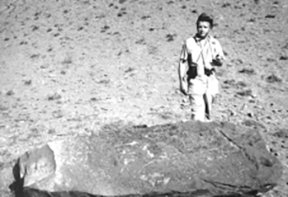
Ronald E. Wyatt (1933–1999)
Wyatt was a nurse anesthetist and a committed biblical literalist who became a prolific amateur investigator. He had no professional archaeological training. His significance is not that he was the first person to see Durupınar, but that he turned it into a durable evangelical “discovery” narrative.
He claimed the formation contained the fossilized remains of the Ark and promoted additional biblical discoveries far beyond Durupınar. Many of these claims were rejected by archaeologists and also criticized by fellow creationists.
The strongest criticism is methodological
Wyatt repeatedly treated ambiguous observations as confirmations of a biblical interpretation: metal readings became fasteners, subsurface patterns became decks or rooms, large stones became anchors, and regional carvings became evidence of Noah’s descendants. The interpretive leap is the issue.
What happened to the people around him?
David Fasold initially became a major advocate, then later expressed serious doubts. Creationist geologists such as Andrew Snelling rejected the Durupınar identification. This is important: skepticism did not originate only from secular archaeology.
Ron Wyatt: important to the story, not an authority on archaeology
Ronald E. Wyatt was a nurse anesthetist who became a prominent amateur biblical explorer. He made a long series of claims about archaeological and biblical discoveries, including the Durupınar formation. His role should neither be erased nor inflated. He is historically important because he helped turn Durupınar into an international Ark story; that does not make his interpretations archaeologically established.
Wyatt's own writings present the formation as an extraordinary convergence of biblical dimensions, location, chemistry, subsurface features and supposed artifacts. The problem is that many of these claims depend on interpretations made by Wyatt himself, often without the documentation, controlled sampling or independent publication expected in professional archaeology.
The strongest criticism is methodological
The most useful criticism is not “Wyatt was a bad person.” It is that extraordinary archaeological claims require a chain of custody and reproducibility. Where was each sample collected? Who collected it? Was it sealed? What laboratory analyzed it? What was the control sample? What alternative materials were tested? Were the results published so other specialists could challenge them?
Wyatt's claims about “petrified wood” illustrate the problem. A rock that resembles wood in the field is not petrified wood merely because it has a fibrous or grain-like appearance. Mineralogy and petrography can distinguish volcanic rock from fossilized plant material. Later geological work has argued that materials promoted as wood are igneous rock, while other researchers have disputed aspects of the overall interpretation. That disagreement is precisely why the samples and methods matter more than the label.
What about the metal detectors and “iron”?
Metal content is another recurring example of an observation being promoted beyond what it establishes. Iron-bearing minerals are common in geological environments. Magnetite, hematite and limonite can produce strong magnetic or chemical signals without being nails, fittings or brackets. To demonstrate manufactured metalwork, the investigators would need to show morphology, composition, manufacturing traces and archaeological context.
The same logic applies to “iron-rich soil.” Elevated iron is evidence of chemistry. It becomes evidence of a ship only after several additional premises are independently demonstrated.
The people around Wyatt
It is also important not to collapse every later researcher into Wyatt's category. David Fasold, for example, became a major participant but later published a geological interpretation with Lorence Collins that rejected the Ark identification. John Baumgardner's early involvement is likewise often cited selectively; his later position was that the site was a natural formation. These reversals are not embarrassing footnotes. They are evidence that investigators can update their conclusions when the physical model changes.
What is fair to say about Wyatt?
It is fair to say that Wyatt promoted claims that are not accepted by professional archaeology and that his evidentiary standards were inadequate for the conclusions he drew. It is not fair to convert every disputed Wyatt story into a proven case of deliberate fraud. Intent requires evidence. This site therefore reserves “scam” for documented deception or materially misleading conduct rather than mere error, overconfidence or unconventional belief.
Deep dive: why extraordinary personal testimony is not enough
Ron Wyatt's importance to the story is undeniable: many modern Ark claims at Durupınar pass through his reports, photographs, talks or later retellings. But historical importance and evidentiary reliability are different things. A person can be central to the origin of a claim without being a reliable authority on the subject.
Wyatt's strongest Ark-related assertions are difficult to evaluate because independent excavation records, laboratory documentation and reproducible sampling are limited. That does not require a claim that Wyatt deliberately fabricated everything. It means the evidential chain is too weak to support the certainty later attached to it.
Deep dive: the “metal” and “wood” category errors
Finding a conductive signal or a material that looks unusual does not identify its archaeological origin. Iron-bearing minerals, weathered rocks, mineralized fractures and modern contamination can all complicate interpretation. Likewise, organic carbon or a wood-like appearance is not equivalent to identifying worked ancient timber. The analytical question is always: what material was sampled, where did it come from, was its context undisturbed, and can an independent laboratory reproduce the result?
What a fair assessment of Wyatt looks like
The defensible conclusion is narrower than either extreme. “Wyatt proved the Ark” goes beyond the evidence. “Wyatt was definitely a deliberate fraud” also requires evidence that is not established merely by scientific criticism. A careful account can say that his methods and evidentiary standards were inadequate for the conclusions he promoted while leaving questions of intent separate.
Sources: Ron Wyatt overview ; Wyatt family archive: 1977 expedition ; Snelling / Creation ; Collins & Fasold .
